
Table of Contents
Properly setting up an air conditioning system affects comfort, energy consumption, and the equipment’s service life. Even a modern air conditioner with incorrect settings can dry out the air, create drafts, and operate under increased load.
Below are practical guidelines: from selecting a mode and temperature to maintenance and common mistakes. These recommendations are suitable for residential split-systems, multi-split systems, and ducted systems in an apartment or office with AC inspection service.
Basic Setting Rules
1) Temperature and Difference from Outside
The optimal indoor temperature for most people is 23–26°C in summer and 20–22°C in winter (with heating mode enabled). It’s important to maintain a safe temperature difference with the outside temperature: 5–8°C is usually enough to avoid discomfort and cold-like reactions.
If the outside temperature is +33°C, setting the temperature to +18°C often leads to overcooling, unnecessary energy consumption, and more frequent compressor cycles. It’s more practical to set the temperature to +25°C and allow the system to stabilize the microclimate.

2) Mode selection: Cool, Dry, Fan, Auto
- Cool – the primary mode for reducing temperature. Use it when it’s hot and you need a consistently cool environment.
- Dry – reduces humidity in moderate temperatures. Useful during the off-season and in areas with high humidity.
- Fan – circulates air without cooling or heating, helping to even out the temperature in the room.
- Auto – convenient, but not always energy-efficient: the system may switch between modes more frequently. Suitable when simplicity is more important than precise control.
3) Adjusting the air flow direction and speed
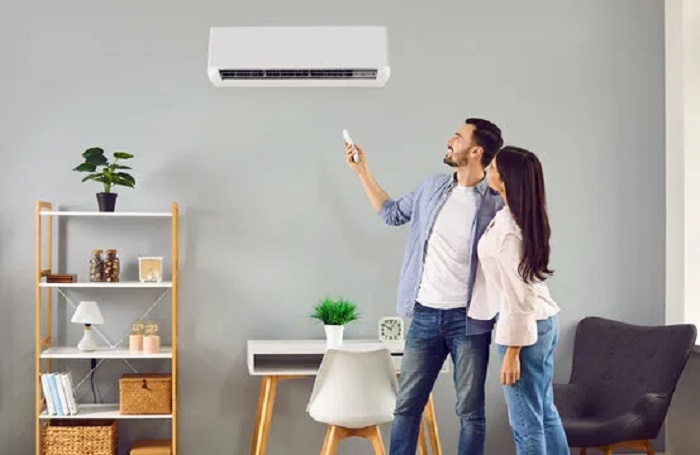
To avoid drafts, direct the air flow along the ceiling in cooling mode and downwards in heating mode. It’s best to select the fan speed as follows:
- High – to quickly reach the set temperature (10–20 minutes).
- Medium – to maintain comfort during active hours.
- Low/Night Mode – for sleeping and working in silence.
If the room has several zones (workspace, bed), avoid direct airflow onto people: comfort is higher with even air circulation.
Checking the power supply and safety devices before starting
Before turning on the air conditioner for the first time after installation or maintenance, ensure that the power supply is correct and that the safety devices are selected and functioning properly. This reduces the risk of compressor, control board, and terminal connection failure due to overheating, phase imbalance, voltage sags, or connection errors.
The test is performed with the line de-energized, observing safety requirements and using serviceable measuring instruments. If there are any doubts about the circuit diagram, cable cross-section, or protection settings, it is best to postpone startup until the parameters are clarified.
What to check before applying power
- Dedicated line: the air conditioner must be connected to a separate circuit breaker, without connections to outlet groups or high-power consumers.
- Voltage compliance: for household models, usually 220–240 V, for some systems, 380–400 V; compare with the equipment datasheet.
- Cable cross-section and type: compliance with the power and cable length; No damage to the insulation, kinks, or signs of heating.
- Quality of terminal connections: tightened according to the manufacturer’s specifications, no stranded wires, correct lugs for stranded wires.
- Correct marking and diagram compliance: L/N/PE or phases on the terminals of the indoor and outdoor units, correct connection of the inter-unit cable.
- Grounding (PE): presence and continuity of the protective conductor, correct connection to the PE busbar.
- Check the circuit breaker: the rating and characteristics must comply with the manufacturer’s recommendations; The circuit breaker should not be set “with a reserve” higher than the permissible value for the cable.
- Check the RCD/RCD circuit breaker: presence of a residual-current device, correct rating, and leakage current (30 mA is often used for household lines, unless this conflicts with the design and manufacturer’s requirements).
- Check for overvoltage: if the network is unstable, protection against surge voltages and lightning strikes is recommended (local, if necessary).
- Measure the voltage under load: after applying power, assess the voltage sags, terminal heating, and the absence of an overheating odor.
- Check for errors upon power-up: during the first start-up, monitor the indicators, ensure there are no protection trips, and that there are no extraneous sounds in the electrical panel and units.
Summary: correct power supply and properly selected protective devices are essential for the safe start-up and stable operation of the air conditioner. Complete the setup only after checking the connection diagram, the quality of the contacts, the presence of grounding, and the functionality of the circuit breaker and RCD/differential protection.